

There is a false idea that is promoted by many in the modern age that science and religion have nothing in common, that they are even enemies. Indeed, many argue that science is about understanding reality and religion is nothing more than mere myth. That last statement reveals a prejudice and an ignorance about “myth,” if nothing else. But, ironically, there is one thing that unites good science and good religion: they are both in pursuit of truth. They approach it differently, but both science and religion hold that truth exists and that it is their purpose to find and reveal it. They are not in opposition to one another; indeed, they can inform one another.
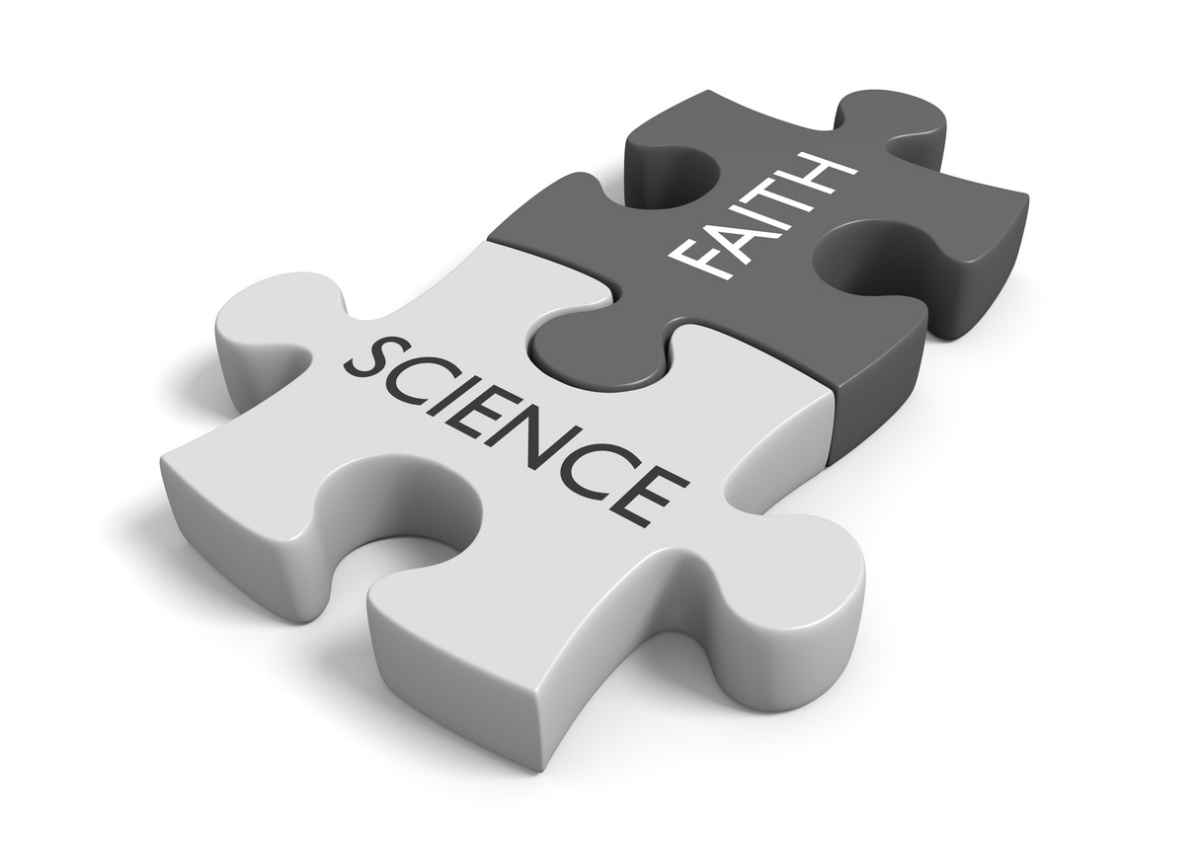
Truth acts like an overwhelming, infinitely powerful magnet that draws both science and faith toward it. Both good science and good theology believe that humility is the most important virtue that must be brought to bear in that noble pursuit of both scientific and theological truth. And both good science and good theology believe that the pursuit of the truth must be conducted in ethical, morally guided ways. In other words, a strong, well-formed knowledge of the good, that is, what is really good as opposed to that which merely appears to be good, is necessary in the honest pursuit of truth, or of that which is more true than other ‘truths’.
Both base their pursuit on demonstrable facts, evidence of many kinds to help them. They recognize that not all facts can be equally true, and not all ‘facts’ are necessarily supported by evidence. They believe that to think critically you have to be able to separate one fact from another, to perceive recognizable patterns, a hierarchy, an observable order among facts, to be able to begin to decide which are actually true, or more true than others. And both recognize the necessity to be open to the surprise of ‘revelation’, or ‘insight ’, both from within and from outside of the solitary self. There are different kinds of revelation.
We live in an era, though, where some in science and philosophy declare, with a certain arrogance, that “God is dead,” that science has replaced our supposed ‘need’ for God. That phrase comes from the writings of the 19th-century philosopher, Friedrich Nietzsche. But it has been taken uncritically out of context and used for less-than-honest purposes, making it seem to many as a statement of fact or truth. What Nietzsche really wrote was, “God is dead, and we killed him, and there will not be enough water to wash away all the blood.” He wrote this insight in his 1882 book, The Gay Science, specifically in his Aphorism #125, titled “The Madman”. He was recognizing some of the profoundly negative effects that the Age of Enlightenment philosophies and the Industrial Revolution had brought upon society and even on faith in his day.
When he says, “we killed him,” we are challenged by a demonstrable fact as well. It is quite evident that many people no longer seek truth in God, but rather claim the power and the authority to determine and to declare what is true and good, according to their own finite judgements alone. Nietzsche made three predictions concerning the future in this way of thinking. In the first, he predicted that it would collapse the ancient foundations of Christian morality, unmoor humanity from its long-held understandings of objective good and evil. It would cause spiritual disorientation, a loss of a moral compass. As a result of this, he warned that humanity would frantically rush to fill this vacuum with secular dogmas, nationalism, and mass political ideologies like socialism and communism, and the present-day equivalents, that would ultimately bring about divisions and violence of a previously unseen magnitude. The bloody, violent 20th Century made his predictions a living reality, and they are still with us today. His third prediction was that there would be growing dominance of the negative philosophy of nihilism, a sense of infinite nothingness, where nothing is any longer meaningful, and levels of doubt and despair would reach unprecedented heights. Does that sound familiar?

C.S. Lewis warned us that the ultimate end of an atheistic science without humility would be the abolition of man, the end of humanity. This is one of the great concerns that arise in the burgeoning early moments of the current “industrial revolution” we are in with the emergence of Artificial Intelligence (AI). A legitimate concern at this moment in time, especially with the incredible speed with which AI is unfolding before our very eyes, would be to ask: “Are those who are engaged in this scientific/engineering pursuit of AI more of the postmodern atheistic science types, who believe that the ends justify the means? Or are they of the scientific bent that is humble enough to believe that there are such things as objective truths, that objective good and evil is discernable, and that those awarenesses should guide their pursuit of AI’s potentials? Do they recognize that, while things are scientifically and technologically possible, both the means used and the ends desired must be objectively good, for the common good?” If the former, we have good reason to be concerned about who is driving the development of this AI “brave new world” in science and engineering. If the latter kind, we have much less to worry about.
A believing Christian, in faith and in humility, is engaged in the pursuit of the divine truth about things that reveals to us how to live a good life in the midst of a broken and often suffering world; how to live a just and merciful life rooted in a true love for God and our neighbors daily during our short lives here on earth. Are we humbly pursuing the One who we believe is the source and the goal of all that is True, Good, and Beautiful in his own being? We have seen the evidence of God’s eternal truth in Jesus Christ, the Word of God. We can imagine and even pursue the kind of world that Jesus desires for us if, in real humility, depending on God’s grace, we try daily to live his way, his truth, and his life. This is an active seeking, not a passive one. We believe that truth and goodness are objectively knowable and experienceable. We are not subdued by the present existential, nihilistic despair of the modern world. The suffering of the world does not cause us despair. We recognize that we are not God, that we have great need for the truth that God offers, so we seek it humbly and courageously, even in the face of suffering.
We seek this divine truth in scripture, in the life, words and deeds of Jesus. We have seen it demonstrated effectively in the lives of the saints over the two millennia of the Church’s history. Yet humility informs our minds and hearts with the knowledge that in our finite and fallen humanity, we must spend our lives dedicated to the difficult, even treacherous pursuit of God’s truth, taking it to heart and trying to live it more and more each day. Jesus, the Word of God, tells us that, “If you abide in my word, you are truly my disciples and you will know the truth and truth will set you free” (Jn. 8:31-32)
More to Explore
SKM: below-content placeholderWhizzco for FHB