

The ancient Jewish Elder, Rabbi Hillel, was once challenged in a debate with his contemporary, Shemmai, a skeptic, to teach the entire Torah to him while he stood on one foot. Hillel then lifted one foot off the ground and, standing on one foot, said, “What is hateful to you, do not do to your neighbor. This is the entire Torah, the rest is commentary–go and learn it.” Then put his lifted foot back down on the ground. Can it be clearer? As we will see, this attitude of love is at the center of all scripture. Rabbi Hillel’s saying has been known to us through the ages as the Golden Rule.

Jesus, too, was asked a similar question by one of the teachers of the law, “Of the commandments, which is the greatest?” (Mk 12:28). Jesus also gave a poignant, pithy response, saying, “The most important one is this: ‘Hear, O Israel: The Lord our God, the Lord is One. Love the Lord your God with all your heart and with all your soul and with all your mind and with all your strength. The Second is this: ‘Love your neighbor as yourself.’ There is no commandment greater than these.” (vs. 29-31) This is the very heart of the Law of God.
It is clear that this divine kind of love is not just, as Hillel said, the entire Torah, but is the heart and soul of the entire Bible from Genesis to Revelation. Depending on the translation, the word ‘love’ appears up to 600 times. The word love, as used in the Sacred Scripture, is different from how it is used and understood in contemporary culture. It is much more than ‘romantic love’, which is driven by emotion, chemistry, and physical desire. The idea of love in Scripture is driven by the will and character of God (Who is Love: 1 Jn 4:8). This scriptural sense of love is sacrificial and gives of itself even if it is not reciprocated or deserved. This level of love is unconditional and is the product of an intentional choice to seek the well-being of another above oneself.
Paul picked up on this theme in his letter to the Romans when he wrote: “Brothers and sisters: owe nothing to anyone, except to love one another; for the one who loves another has fulfilled the law.” Read that again: “for the one who loves another has fulfilled the law.” Paul then speaks of several of the commandments of the Decalogue that relate to how we treat our neighbor: “You shall not commit adultery; you shall not kill; you shall not steal; you shall not covet…” adding then, “You shall love your neighbor as yourself. Love does no evil to the neighbor; hence love is the fulfillment of the law.” (Rm. 13:8-10). We were given these commandments from God because, in our brokenness, we often arrogantly defy the level of love that is referred to in Scripture. We do not fulfill the law. If we loved in the manner God desires of us, we would not need those “thou shall nots”, for we ‘be the law’ in our daily lives.

The ‘love’ that we are being taught to live in the Scriptures is not easy. It is not easy in reality precisely because we are sinners. We sin sometimes out of simple ignorance of God’s law, and sometimes out of foolish, prideful arrogance. To grow out of those tendencies in life that cause us to fall short of living the fullness of God’s love, we must willingly and humbly choose to struggle against them through prayer, contemplation of the Scriptures, and regular church attendance. Finally, we need to practice the demands of this love in real-life situations, even if we do so stumblingly, imperfectly, and often fail.
But we have reason for hope. God knows us through and through. He knows our weakness, but He also knows the deepest desires of our hearts. To love in the manner God calls us to requires knowing and conscious choices on our part. We have been given the Holy Scripture to read about and to witness God’s love in action in Jesus. If we go to the Scriptures and to prayer willingly, openly, and diligently, we may very well fall in love with God with our whole hearts, minds, and strength. If, by God’s grace, we come to love God with all of our being, then choosing to love our neighbors as ourselves will become not only reasonable but possible in the reality of our lives. Is this not what the world so desperately needs now, without really knowing it?
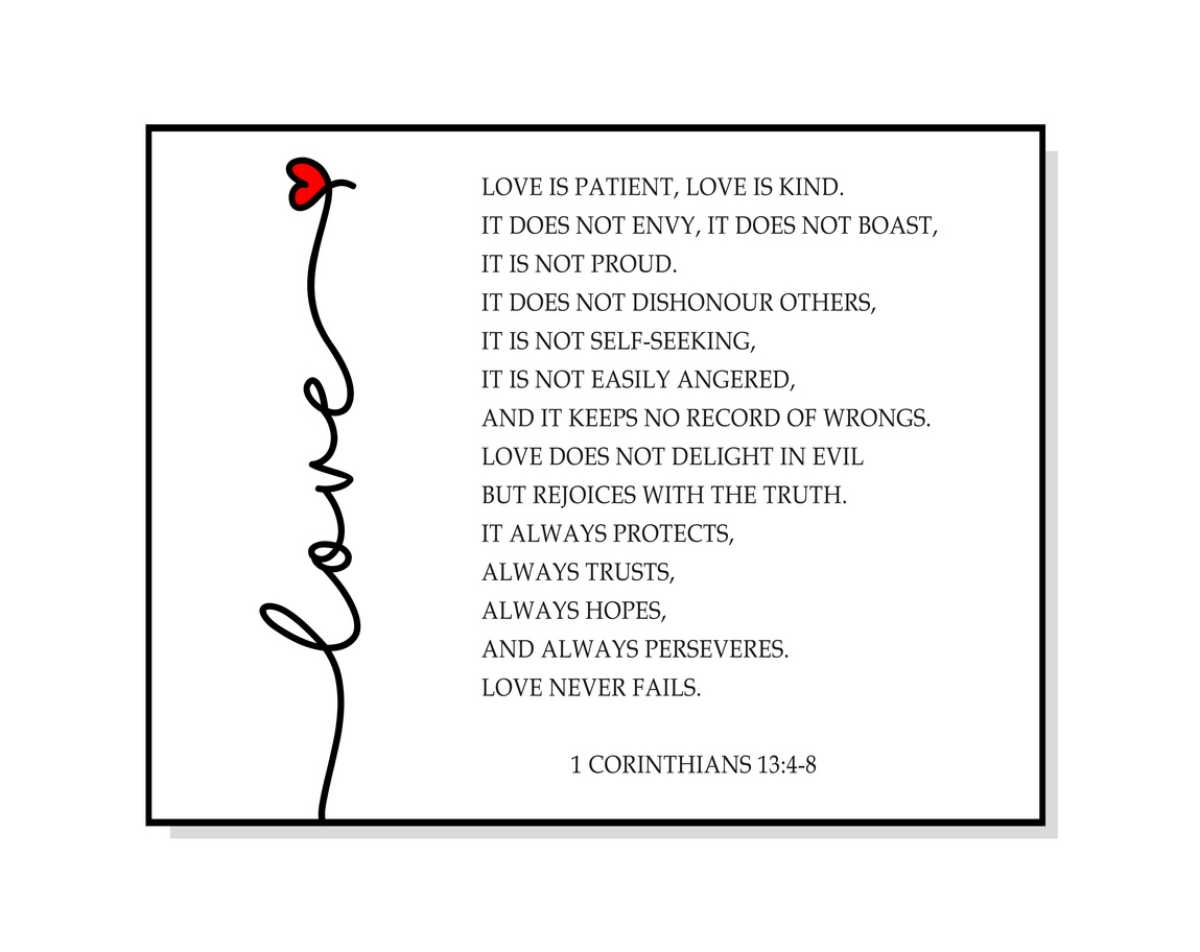
Paul also tells us what that fullness of love would look like in real terms when he writes: “Love is patient, love is kind. It is not jealous, it is not pompous, it is not inflated, it is not rude, it does not seek its own interests, it is not quick-tempered, it does not brood over injury, it does not rejoice over wrongdoing but rejoices with the truth. It bears all things, believes all things, hopes all things, endures all things.” (Rm 13:4-7) Given these words from Scripture, we would have to admit two things: This level of love is not practiced widely or well, either in society at large or, sadly, all too often, not even in the realm of the Christian Church. Secondly, we Christians have a great deal of room to grow in our calling and our responsibility to love God and our neighbor in the way Jesus has modeled to us.
Paul, again, in Ephesians tells us: “So be imitators of God, as beloved children, and live in love, as Christ loved us and handed himself over for us as a sacrificial offering to God for a fragrant aroma.” (Eph. 5: 1-2) Yes! Let us begin again to imitate Jesus’ love for the Father and for our neighbors. We will fall short at times; we may ‘miss the mark’ at times, in great and small ways, but God sees the intentions of our hearts. If we truly desire to love God and neighbor, we can be confident that God’s love and mercy toward us will always be unconditional and swift. He will respond to our prayerful desires to become his faithful followers in love with unlimited graces. All we have to do is remember that “If God is for us, who can be against us?” (Rm. 8: 31)
More to Explore
SKM: below-content placeholderWhizzco for FHB