

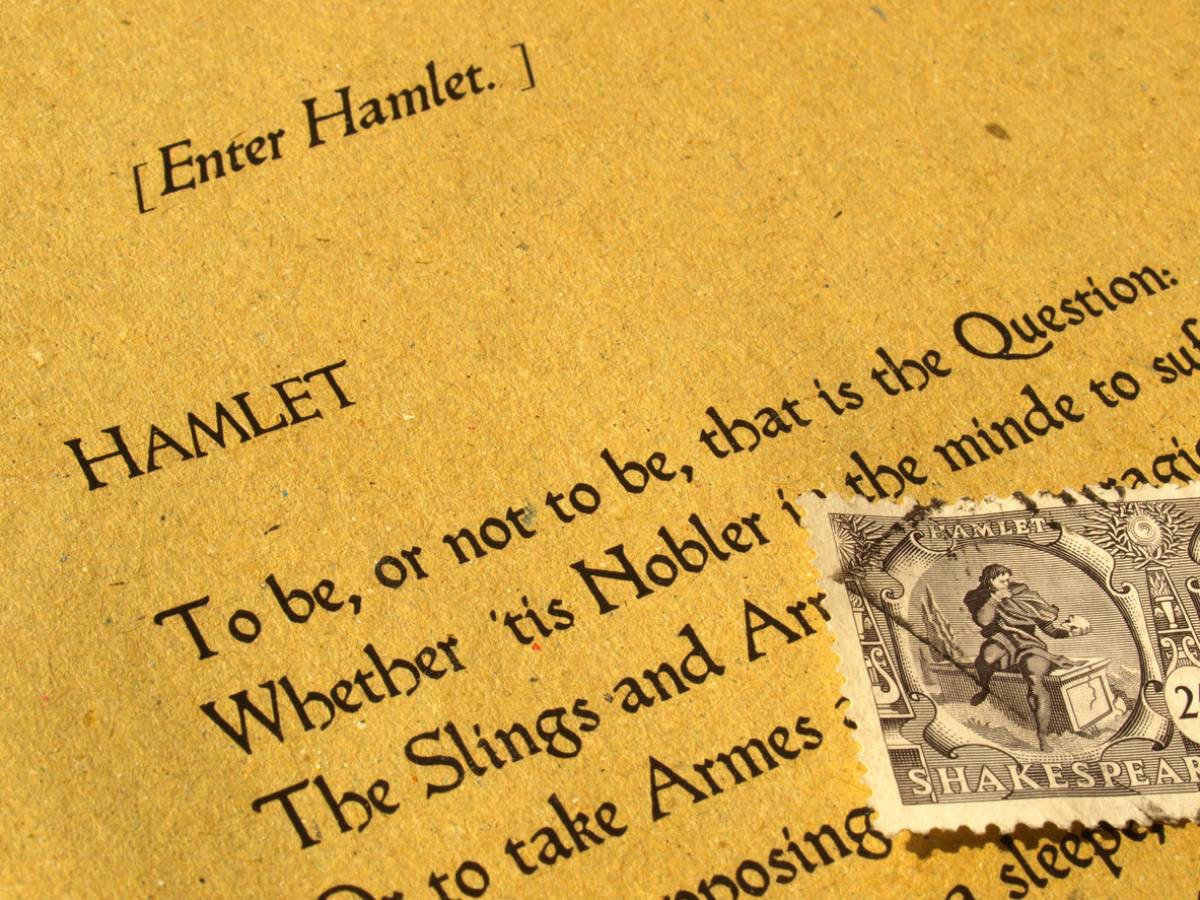
In Shakespeare’s play, Hamlet, Prince of Denmark, the character, Polonius, who is sent to spy on Hamlet by Hamlet’s uncle, who presently has assumed the throne of Denmark, comes upon Hamlet reading and asks him what it is that he is reading. Hamlet, full of sorrow and suspicions around the sudden death of his father, responds with a dismissive phrase, “Words, words, words.” Hamlet’s whole world has been turned upside down. In sorrow and disillusionment with the world, he trusts no one’s words. There is an atmosphere of falsehood everywhere around him. Words have become empty to him. This is a perfect prescription for tragedy.
Human history often reveals that people use words to deceive, manipulate, and confuse others to fulfill personal, immediate, and finite passions or desires. That is the whole purpose and function of a lie after all. But, just as it is true in physics, that every action has an equal and opposite reaction; every word (true or false) and deed (right or wrong) has its consequences, seen or unseen, intended or unintended.
The opening of John’s Gospel introduces us to a profound truth about Jesus. He writes: “In the beginning was the Word and the Word was with God, and the Word was God” (Jn. 1:1). He tells us that through that Word “all things came to be, and without that Word nothing came to be” (v. 3). We believe that Jesus is the Word of God, and as such, he is the source and goal of all that is really good, true, and beautiful. Indeed, he says of himself, “I am the way, the truth, and the life. No one comes to that Father except through me” (Jn. 14:6). Jesus is, as they say in the law, “the Truth, the whole Truth and nothing but the Truth”.
In the 6th chapter of John, we see that after Jesus has given his Bread of Life discourse, many of his followers turn away from him, unable to accept his words. He then turns to the Twelve and asks them, point blank (just as he is asking you and I right now), “Do you also want to leave?” and Peter responds, “Master, to whom shall we go? You have the words of eternal life” (Jn. 6: 67-68). If we really believe that the words of Jesus and of the Gospels are true, indeed, the fullness of truth, the “words of eternal life”, then why is there so much that is untrue and false all around us and within ourselves? Why is there so much suffering and injustice? Indeed, why does ideology, in all of its forms, hold more sway today than the Word of God?

We say we believe that Jesus has the words of eternal life, but what is the evidence that we are living out of this truth? If we believe that the ways of God are indeed true, the evidence that we are living in accord with that belief ought to be seen in a demonstrable growth in our love for God and for our neighbor, even our ‘enemies’. Is there a recognizable growth of our wisdom, our sense of joy, our love of truth, and our commitment to life at all stages, in every way? If, on the other hand, we are experiencing only endless foolishness, suffering, darkness, and death, ought this imply to us that there might be a problem that we need to address, for our own good, and for the good of all others?
C.S. Lewis wrote this in his book, Mere Christianity, “If you read history you will find that the Christians who did most for the present world were just those who thought most of the next…It is since Christians have largely ceased to think of the other world that they have become so ineffective in this world. Aim at Heaven, and you will get earth ‘thrown in’: aim at earth, and you will get neither.”
To believe that Jesus has given us “the words of eternal life” is to believe that the way to eternal life is by living those “words of eternal life” humbly, joyfully, intentionally, meaningfully, and courageously in our daily lives. All else, all other ways, are false. To live by any other ‘truth,’ is to lose both heaven and earth, to be lost.

Our present times are caught up in an ever more destructive whirlwind of ideologies and lies pretending to be truths. This is so in all elements of our society, in the economy, in our politics, and in the countless false divisions within the Body of Christ, the Church. It is a proper self-reflection for a Christian, then, to ask oneself. “Am I aiming at the things of Heaven, or the things of the earth? To follow the ‘wisdoms’ of this world, to give them greater importance than Jesus’ “words of eternal life,” is truly dangerous to our own personal lives here and now, to the life of the nation here and now, and, ultimately, to our eternal souls.
Do we believe Jesus’ words when he says, “You will live in my love if you keep my commandments” (Jn. 15:10)? Only the words of the Word of God, Jesus Christ, have in them the hope and the reality of eternal life (as well as for the hope and reality of a better world in the here and now). “If I find in myself desires which nothing in the world can satisfy, the only logical explanation is that I was made for another world.” C.S. Lewis (Mere Christianity) Let us pray diligently for the wisdom and the faith to live in accord with Jesus’ “words of eternal life.” Amen.
More to Explore
SKM: below-content placeholderWhizzco for FHB