

This is a very powerful story from the First Book of Kings. It takes place in yet another very difficult moment in Jewish history. The Jewish people, under the foul king Ahab, had forsaken the commands of the Lord and had apparently become wishy-washy, comfortable with worshipping many gods alongside their Jewish faith’s command to worship one God. Elijah steps into the breach at Mount Carmel, alone, against the 450 prophets of the Canaanite rain god, Baal, to prove that there is, indeed, but one God who is Lord over all. There may be some very significant similarities here with current history.
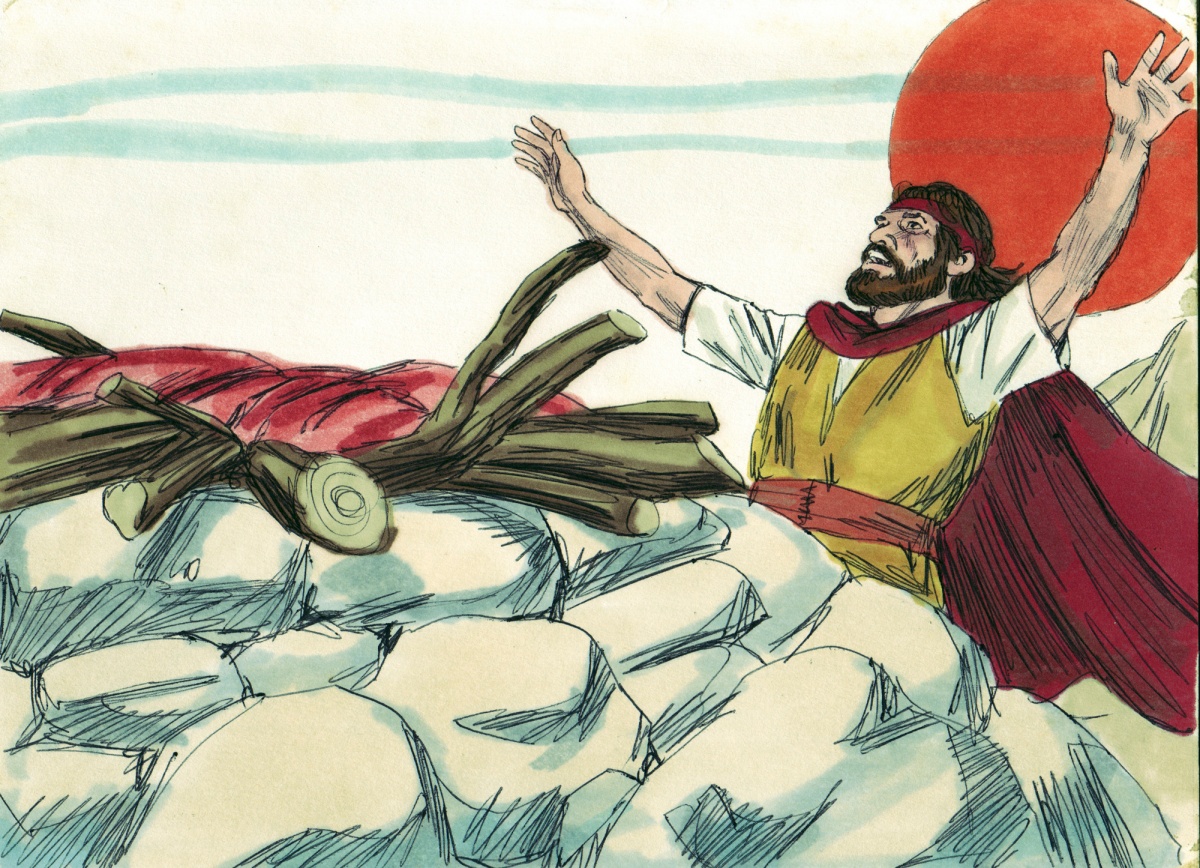
When the people and the prophets of Baal had assembled, Elijah approached them and uttered a profoundly challenging question to the Jews; “How long will you straddle this issue? If the Lord is God, follow him; if Baal, follow him” (1 Kings 18: 21). And we are told that the people ‘did not answer him’. What follows is a dramatic account of the challenge that Elijah proposes to the prophets of Baal. He tells them to pick two young bulls for a sacrifice. One is to be for the prophets of Baal, the other for him. They are told to slaughter their bull and put it on the altar of wood, but to start no fire. Elijah would do the same, but with some significant differences, as we will see. He challenges them to call upon the names of their gods, and he will call on the name of the Lord, saying, “The God who answers with fire is God” (v. 24), ‘and all agreed.’
Long story short, the prophets of Baal call on their god all morning, crying out to Baal to answer with fire; there is nothing but silence, no response. Elijah challenges them at noon, saying, “Call louder, for he is a god; he may be busy doing his business, or may be on a journey. Perhaps he is asleep and must be awakened” (v. 27). You can almost hear the satire in his voice. The prophets of Baal cry louder and dance around the altar, cutting themselves with swords and spears all afternoon. Nothing. “No one was listening” (v. 29).
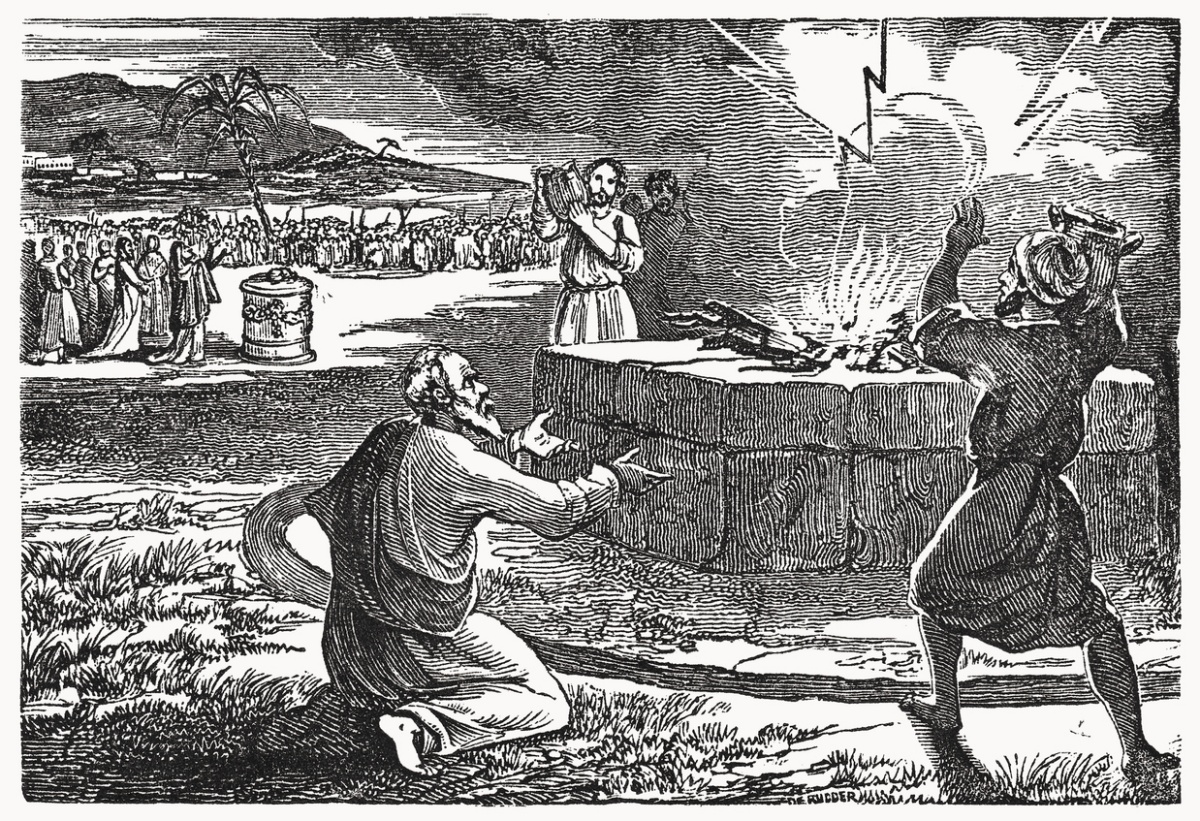
Then Elijah built up his own altar with twelve stones representing the tribes of Israel, built up the pile of wood, and had a trench dug around the altar. He then orders, three times, that water be poured over the wood and the altar until everything is drenched and even the trench is filled with water. Then he calls on the God of Abraham, Isaac, and Israel: “Let it be known this day that you are God in Israel and that I am your servant and have done all these things at your command. Answer me, Lord? Answer me so that this people may know that you, Lord, are God and that you have turned their hearts back to you” (vs. 36-37). With that, the Fire of God came down and devoured everything, even drying up the water in the trenches. “And the people fell prostrate, saying, ‘The Lord is God! The Lord is God!” (v. 39).
What does this magnificently dramatic story have to say to us now? In many ways, our times may not be so dissimilar. Though we would never admit it because, of course, ‘we are not like them’. We have matured and grown beyond those primitive, “mythological” worldviews. We are modern, more sophisticated. We have science and technology to explain the world. Science and our technologies have given us power over nature, and we are learning more and more every day.
So, are we really that different? Do we not, in our own ways, give god-like worship to “science and technology” and all manner of other gods of our own making? Indeed, haven’t we, in our presumed ‘sophistication’, made ourselves into demanding self-serving gods entitled to whatever appeals to our desires? We make gods of sex in manifold forms, of ideologies and ‘isms’ of countless kinds. We give inordinate amounts of our time and energy to the pursuit of money or power in all of its forms, from the personal to the national. But do they really bring us the happiness that we so deeply desire? Or are our gods not just as arbitrary and demanding, both personally and of others? Ultimately, are they not often as cold and cruel as those of ancient times?
Elijah’s rhetorical question is just as challenging to us Christians today as it was to the Jews then. “How long are you going to straddle this issue?” Jesus told us, “No one can serve two masters. Either you will hate the one and love the other, or you will be devoted to the one and despise the other. You cannot serve both God and mammon (money, power, any ideology, whether sexual, social or political, or any political party). God is God alone.

If we find ourselves caught up in ‘straddling’ this issue, we need to take ourselves apart purposefully. We must go to prayer, take refuge from the noise, go into ‘desert places’ of solitude and silence, and engage in this spiritual combat, for the good of our own lives, and those of others. We need to confront the effects of the dictatorship of this world filled with idols that gorge themselves on technology and material goods; a world dominated and manipulated by social media; a world that flees from, ignores, or even hates God. Only when we can give our whole selves to God and neighbor, keeping the commandments, will we be able to come to know the fire of God’s all-consuming love. Only then will we be able to say with our whole being, “The Lord is God! The Lord is God!
More to Explore
SKM: below-content placeholderWhizzco for FHB