

Scapegoating is so common in the experience of human communities that it is regularly unrecognized for what it really is. Scapegoating unfairly directs blame for complex problems, failures, or frustrations onto individuals, or at the national level, on those seen as ‘outsiders’, or those who are seen as ‘different’ in any way. This behavior can take on the qualities of group bullying and can be seen at work in the dysfunctional dynamics of struggling families, in group dynamics, or at the national level, in public policies. We see this scapegoating dynamic at play here in the passage about the adulterous woman in John’s Gospel (John 8:1-11). What are we to learn from it?

The Gospels uncover the disordered, even demonic character of scapegoating with a particular clarity in this passage. The scribes and the Pharisees bring a ‘woman caught in the act of adultery’ before Jesus, claiming to be ‘eyewitnesses’ of this act. In his writings, René Girard argued that those who scapegoat often appeal to religion to support their positions, believing that the appeal to religion will bring the group together. The Pharisees came to Jesus as a religious authority and, in an effort to tempt him, to gain ‘evidence’ against him, they confidently quote scripture to him, “Now the law of Moses commanded us to stone such a woman. Now what do you say” (Jn. 8: 5)?
Jesus does not take the bait. He refuses to contribute to the energy of this scapegoating storm. He “bent down and wrote with his finger on the ground” (v. 6). By refusing to participate in their self-righteous, distorted views, he broke the momentum of their efforts to group-bully this woman. And we must not forget the deeply violent intentions of their efforts, both toward the woman and toward Jesus.
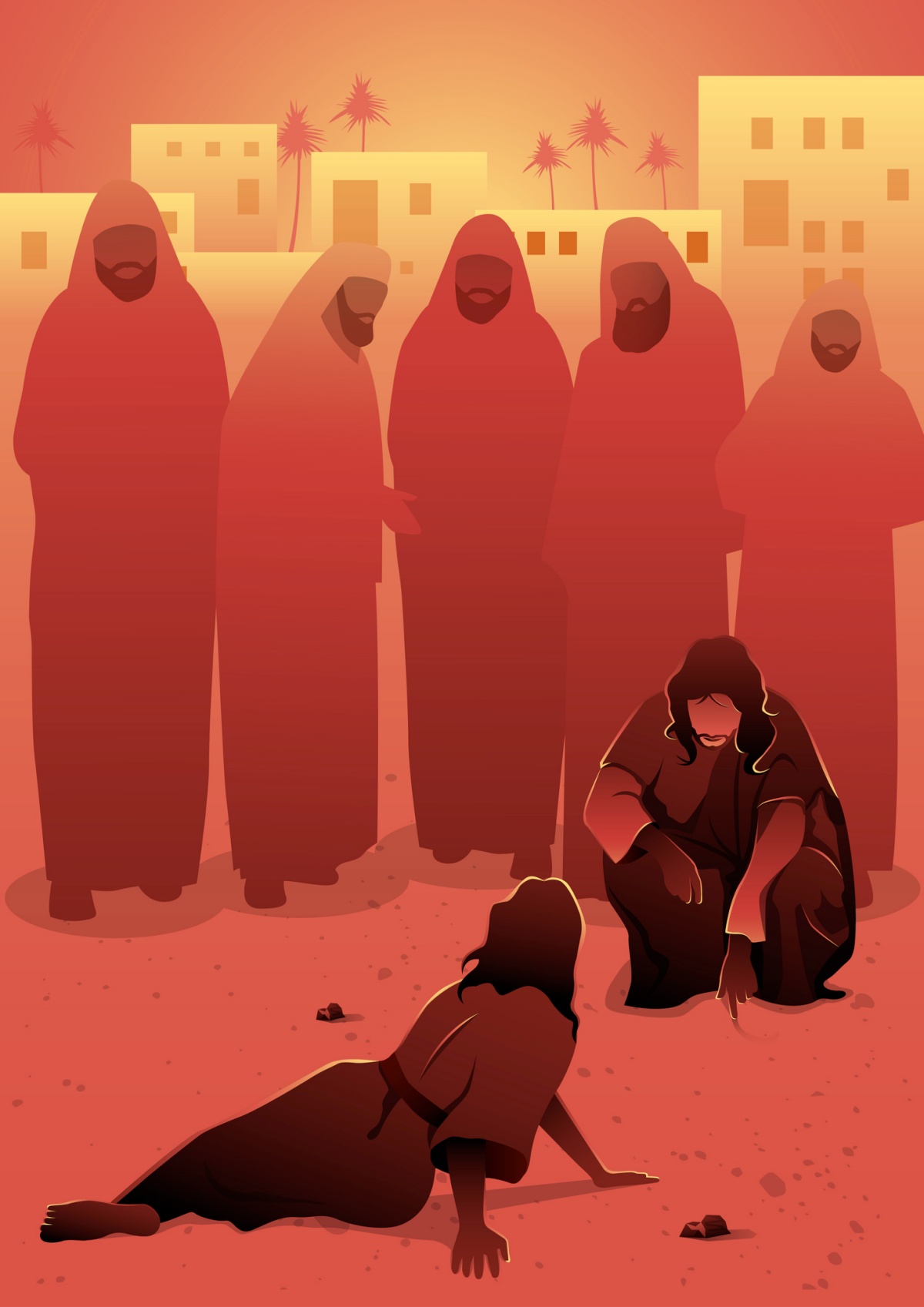
Jesus is showing us something new here, something different in the most profound sense. He is directing our attention to a behavior that we have fallen into at one time or another, or are easily tempted toward, especially when things feel chaotic all around us. He shows us a better way to confront the complex, difficult tensions in our personal lives and those perceived and experienced at the societal level. He is showing us a better way, a more effective, more life-giving way. He is showing us a Christian way to deal with such things.
We can’t help but wonder what Jesus wrote in the sand with his finger. The Church Fathers imagined that what Jesus wrote was the various sins of the woman’s accusers. We can see how that would redirect the ‘finger-pointing’ of the accusers away from the woman and back at themselves. It would have forced them to see the previously unseen connection between themselves and the woman they were accusing. Jesus made the accusers aware of the depths of their own sinfulness and their own need for compassion and forgiveness. And, as a result, they all walk silently away. This gets at the heart of the Gospels.
The Pharisees were confronted with the truth about themselves. The same is true about ourselves. We might be reminded here of Jesus’ words, “The truth will set you free (Jn. 8: 31). So much of Sacred Scripture is a contradiction to this destructive habit, this false narrative, this sin of scapegoating. We see it revealed for what it is in Adam’s attempt to blame Eve and thereby separate himself from his own guilt, and Eve’s attempt to free herself from her own guilt by blaming the serpent. We see it in the Pharisees’ efforts to scapegoat the woman in this passage. This sin of scapegoating continues to be the cause of much of the harm, division, and violence that governs our times.

There is an old Dionne Warwick song that proclaims, “What the world needs now is love, sweet love, that’s the only thing there is much too little of.” John tells us and shows us in his 1st Letter that “God is love” (1 Jn. 4:8). With the overt amount of scapegoating we see in our headlines these days, it seems quite clear that there is too little of God and way too much of human self-righteousness in our day, too. As Christians, we are called upon to be and to act in the world differently, a way that unites rather than divides, the way of Jesus Christ, the way of compassion and forgiveness.
The community that Jesus calls us to is one rooted in our recognition of ourselves as broken sinners one and all in mutual need of God’s compassion and forgiveness. As such, we are to recognize that we are all more alike than unalike. When we recognize our need for forgiveness, we are enabled to see the same soul-deep need in all others. As Christians, this holy insight inspires in us the holy desire to be compassionate and forgiving, rather than judgmental toward others.
We are called upon to break free of communities built upon the false foundations of scapegoating, and to form new communities rooted in true justice, compassion, and forgiveness, that is, communities rooted in the way, the truth, and the life of Jesus Christ. Is there anything more needed than this in our own most intimate lives, the life of our nation, or the life of the world at our own present moment?

Let us pray: When evil tempts us to prejudice and dark deeds toward those we perceive to be “different” from us, or when the struggle to be compassionate or to forgive another person ‘disturbs’ us, or when gossip lures us into judging others, without recognizing our own faults and failures, or when our faith wavers in the face of suffering, we pray: Save us O, Lord of infinite compassion and forgiveness. Amen.
SKM: below-content placeholderWhizzco for FHB