

Jesus’ words in this passage could be seen as controversial, exclusivist, even harsh, but only if they are taken out of context. This is the only time that Jesus journeyed outside of the borders of Israel during his ministry. This event takes place in the city of Tyre, modern-day Lebanon. The Canaanite woman at the center of this passage would be considered a ‘foreigner’, both culturally and, more importantly, religiously by the Jews at this time. But all of this makes her presence, her actions, and her words here that much more significant. They give us even greater insight into Jesus’ words and their universal and challenging message.
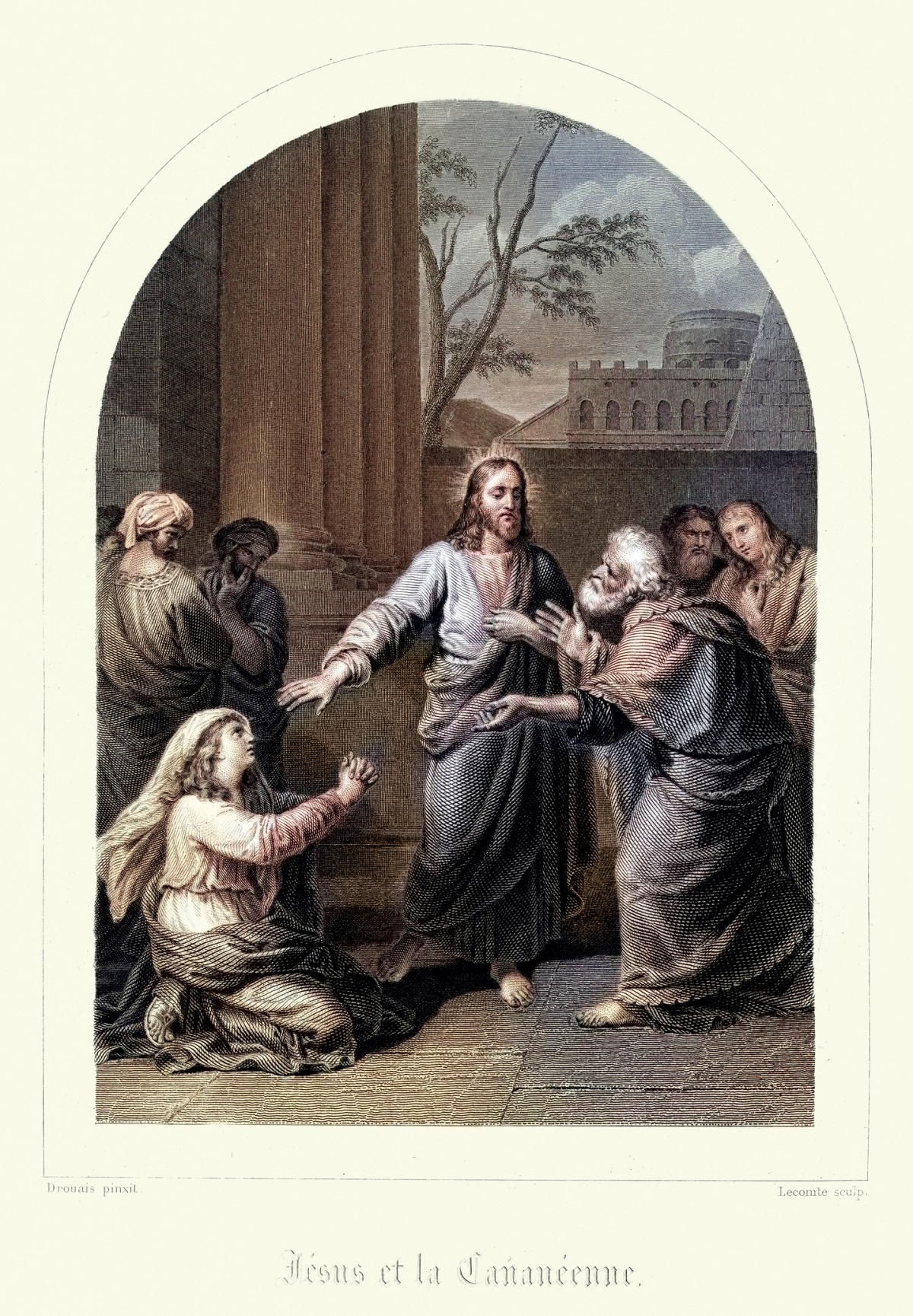
This Canaanite woman, this foreigner, calls out from the midst of the crowd, exclaiming, “Have pity on me, Lord, Son of David! My daughter is tormented by a demon” (Mt. 15: 22). The first thing we need to reflect on here is how she addresses Jesus. She does not address him as even his followers would most naturally address him, as “Rabbi”; rather, she calls him “Lord.” Her choice of words here should strike us deeply. This Canaanite woman, this foreigner, this non-Jew, seems to have intuited who Jesus is. We can assume that it is by the grace of God that she has come to this very deep level of faith. She addresses Jesus as, “Lord, Son of David!” Her intuition about Jesus, and love for her daughter, moves her to ask Jesus for his pity, his mercy. Initially, Jesus responds to her with what seems like a stony silence.
The disciples are frustrated too by her persistent efforts, and they ask Jesus to “Send her away, for she keeps calling out after us” (v. 23). They are embarrassed by her, even angry. And we hear Jesus saying, for all to hear, “I was sent only to the lost sheep of the house of Israel” (v. 24). Remember that his words are being heard by both the Canaanites and his Jewish followers. We can imagine their different responses. But the woman, out of her desperate love and concern for her daughter, kneels and prostrates herself (a very significant gesture) before Jesus, saying again, “Lord, help me” (v. 25). Again, we are to hear her use of the word “Lord”. Yet, Jesus stuns us again with a response using language that seems outright cruel. “It is not right to take the food of the children and throw it to the dogs” (v. 26). This seems so out of character to us.
For a third time, we hear this Canaanite woman address Jesus as ‘Lord,’ saying, “Please, Lord, yet even the dogs eat the scraps that fall from the table of their masters” (v. 27). What profound insight, so plainly spoken! And Jesus responds, O woman, great is your faith! Let it be done for you as you wish. And the woman’s daughter was healed from that hour” (v. 28). We know that Jesus does not do anything, or allow anything to happen, that is void of meaning, indeed, infinitely important meaning. What are we to take from this seemingly strange event? Just the fact that a miracle took place? Or something more directly related to our own lives as disciples of Jesus?
It seems to me that there are three important points to be taken from this passage. The first thing that strikes me is this woman’s persistence. Her humble persistence gives us an example of both faith and prayer. She models both to us. It also reminds us of other passages in Matthew and in Luke, where Jesus tells us, “Ask and it will be given to you; seek, and you will find; knock and the door will be opened to you…” (Mt. 7:7-8, Lk. 11:9-10). We, too, can be persistent like this Canaanite woman because we know, in faith, that God will answer us. It is faith in Jesus that moves this Canaanite woman to be so persistent. We, too, need to be persistent in our faith and in our prayer, especially when we are experiencing challenging times. God will answer us according to his infinite wisdom and at the proper time.
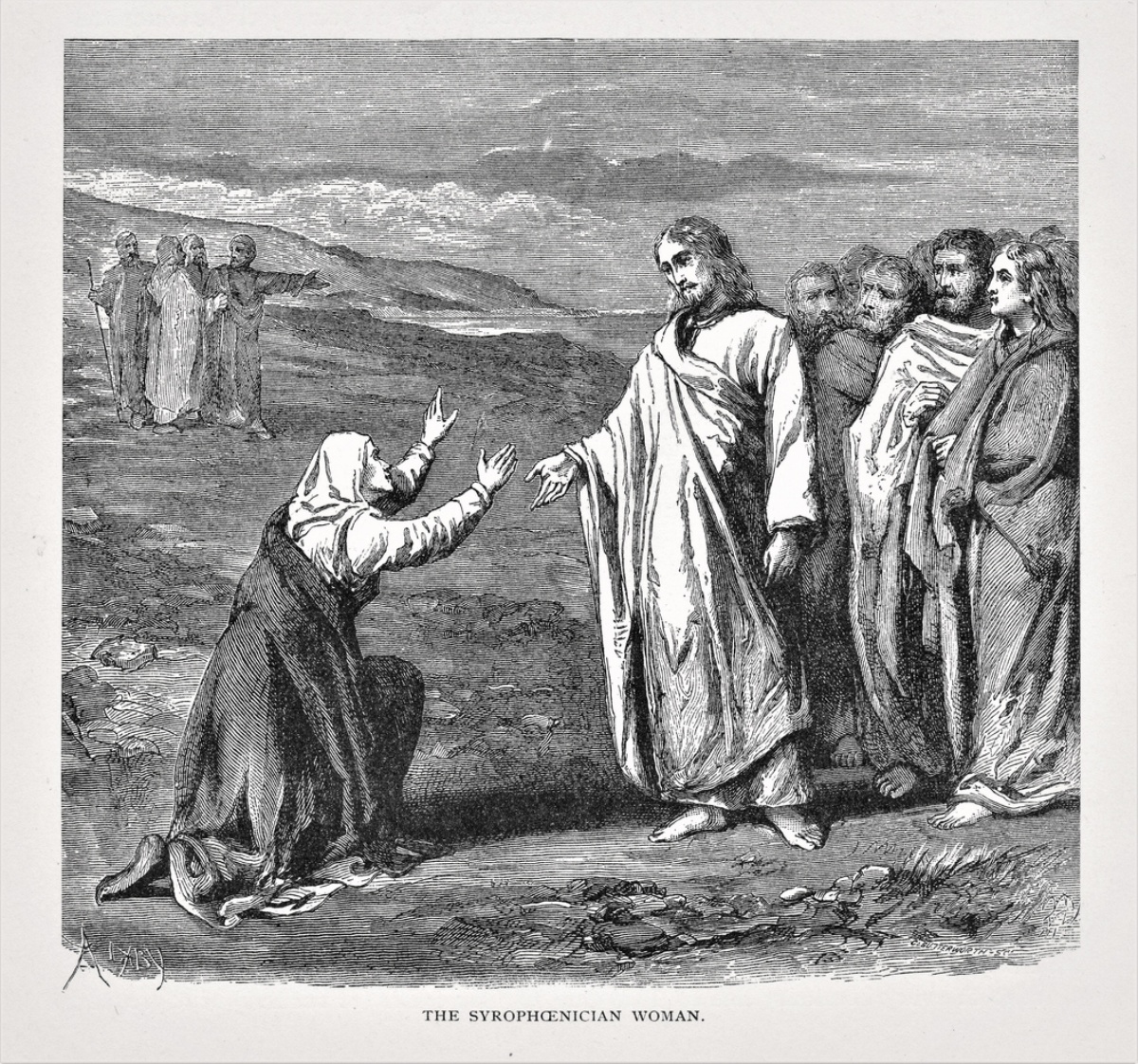
And this brings us to the second point. She is clearly moved by love for her daughter. Her love is self-sacrificing. She is taking a real chance here in putting herself out in such a public way. She risks being ignored, ridiculed, and rejected, or worse, being beaten for her affront, possibly by either her own people or by the Jews. She, though, is not doing this for herself; she is doing it out of her self-giving love for her daughter. She is also a model of faith for us. She knows at an instinctive level who Jesus is and believes in him, in his power, and in his love. Her persistent prayer, then, is rooted in her love for her daughter and in her instinctive faith that Jesus will respond to such a love with an even greater love, and her daughter will be healed. She is an example for us of both faith and love, lived openly, no matter the cost to the self. And as we see in the end, Jesus has seen her faith and love all along. His comments have led her to this most profound insight.
And this is the third, very important point: This foreign woman’s insight that even the dogs eat the scraps from their master’s table reveals that Jesus came into the world to bring all peoples into the kingdom of heaven. The Jews are still the Chosen People. Israel was chosen as the means through which God came into the world and took on humanity in his Only Son, Jesus. Yes, Israel was chosen, but as we see in Jesus’ life, death, and resurrection, it was not just for the sake of Israel. In the end, it was for the sake of the whole world.

Let us pray persistently to that Lord, then, that all of the wounds of division among us, in the Church and in society, may be healed, that our fears may be turned into understanding and a growing care for one another, and that we may be strengthened in love so that we may all work through the wisdom of Christian charity to finally become one in the faith, the hope, and the love that You, Father, have called us to in Jesus Christ, our Lord. Amen.
More to Explore
SKM: below-content placeholderWhizzco for FHB